Fiber Miles Matter: A Buyer’s Map for Regional Recycled Paper Sourcing

For many US procurement teams, recycled content has become a familiar checkbox. A carton may carry a high recycled percentage, a mailer may advertise post-consumer fiber, and a supplier may provide a certificate that looks clean on paper. Yet none of those signals answers a more practical question: where did the fiber come from, where was it processed, and how far did it travel before it reached the converting plant or the customer?
That question sits at the center of what this publication calls fiber-shed thinking. A fiber shed is the geographic area in which recovered paper is generated and in which mills can economically consume it. When a buyer specifies recycled paper without understanding the fiber shed, the result can be a circular claim that is technically true but operationally thin. The material may be recycled, but the loop may be long, fragile, and difficult to verify.
Why fiber distance belongs in the specification
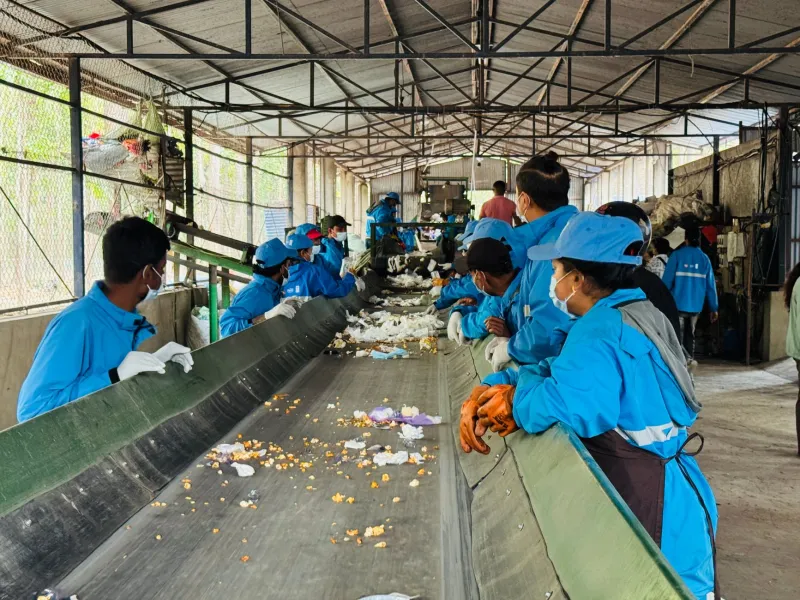
Paper recycling is not a single act. It is a chain: collection, sorting at a materials recovery facility, baling, transport to a mill, repulping, and conversion into new paper or packaging. Each link has a location. Each location affects cost, emissions, and resilience.
The 300-mile fiber rule is not a regulation or an industry standard. It is a screening discipline. As a heuristic, it asks buyers to treat fiber distance as a material variable rather than an afterthought. If recovered fiber is collected in one region, shipped several hundred miles to a mill, and then shipped again as finished packaging, the circular loop may still be preferable to virgin fiber in some cases. But the buyer should know that the loop is longer and should be able to explain why the trade-off makes sense.
Regional mill capacity is the other half of the equation. A city can generate enormous volumes of recovered paper and still lack nearby mills able to consume that fiber. In that case, bales may move by truck or rail to another region, or to export markets. A procurement team that counts only recycled content will miss the capacity constraint that determines whether a local loop is real.
Map the fiber shed before you negotiate
A useful sourcing review starts with a simple map. For each paper grade under consideration, ask where the recovered fiber is collected, which materials recovery facilities handle it, which mills can process it, and which converting plants turn it into the finished product. Then mark the distances between those nodes.
The map does not need to be perfect. It needs to be honest. Buyers should request mill-level origin information rather than national averages. They should ask whether the supplier uses a single mill or a network, whether the recovered fiber is post-consumer or post-industrial, and whether the mill has capacity constraints during peak seasons. A supplier that cannot answer those questions is not necessarily a poor supplier, but the buyer should treat the recycled-content claim as unverified until the chain is clearer.
Transportation mode matters as well. Truck, rail, and intermodal freight have different emissions profiles per ton-mile, and backhaul arrangements can change the picture. A longer rail haul may sometimes be preferable to a shorter truck haul, depending on volume and routing. The point is not to memorize a single distance threshold. The point is to compare distance, mode, mill efficiency, and recycled-content yield together.
Surplus and deficit regions in the US
Regional patterns in the United States are uneven. Dense urban corridors in the Northeast and Mid-Atlantic generally generate large volumes of recovered fiber, but local mill capacity and export dynamics can shape where those bales go. Parts of the Midwest and Southeast have significant recycled containerboard and papermaking capacity, which can make them attractive destinations for recovered fiber from nearby states. California combines strong generation with port access, permitting constraints, and long internal distances, so the fiber shed can look very different from one part of the state to another.
At the other end of the spectrum, parts of the Mountain West and Northern Plains have lower population density and fewer nearby recycled-paper mills. A buyer in those regions may face longer hauls to reach a mill that can consume the grade. That does not make recycled paper impossible or irresponsible. It does mean the procurement case should acknowledge the added freight and should test whether a different grade, supplier, or packaging design reduces the mismatch.
These are general patterns, not rules. Mill openings, closures, and capacity changes can shift a fiber shed quickly. The buyer’s job is to verify the current picture rather than rely on a stale regional stereotype.
A buyer checklist for regional recycled paper
- Identify the likely fiber shed for each paper grade, including collection, sorting, milling, and converting locations.
- Request mill-level origin data and the distance from the materials recovery facility to the mill.
- Ask which freight modes are used and whether backhaul or consolidated shipping reduces the effective distance.
- Confirm that the mill has capacity for the grade and volume you need, especially during peak packaging seasons.
- Compare recycled-content claims with the actual fiber path rather than accepting a national average.
- Model transportation emissions alongside recycled-content gains, and document the trade-off in the sourcing file.
- Include a review clause in the contract so the fiber shed can be reassessed if the supplier changes mills or sources.
- Run a pilot order before scaling, and verify that the finished packaging performs as specified.
When a longer haul can still be justified
A regional test should not become a rigid border. Some grades are specialized, some food-contact applications require particular mill capabilities, and some volumes are too small to support a local loop. In those cases, a longer haul may be the better option. The procurement team should simply say so plainly and document the reason.
The stronger position is not to claim that every recycled paper purchase is local. It is to know which purchases are local, which are regional, and which depend on a longer chain. That knowledge turns recycled content from a marketing phrase into a sourcing decision that can be defended to operations, finance, and sustainability teams alike.