The Pallet Corner Is the Judge: Field-Testing Paper Load Stabilization in 2026
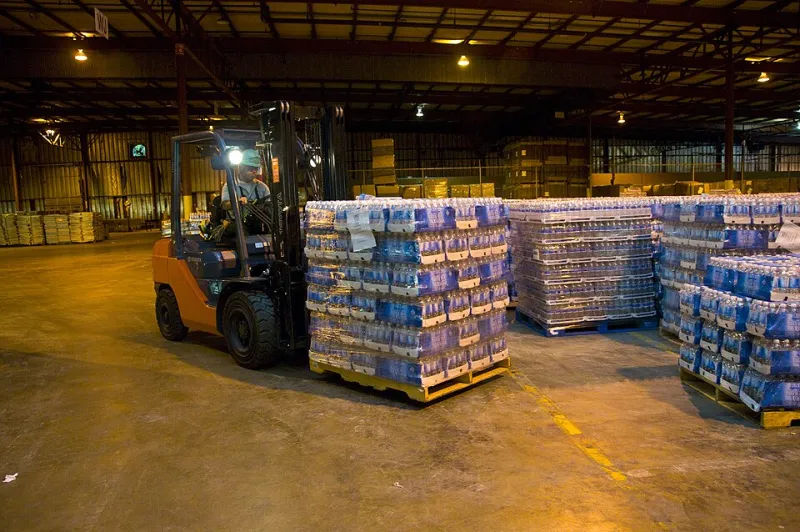
Photo: Patsy Lynch, Public domain, via Wikimedia Commons
Every procurement team under pressure to cut plastic from outbound freight eventually reaches the same conversation. Stretch wrap is on the way out, the reasoning goes, and paper can do the same job. Sometimes it can. But the substitution is rarely a one-for-one swap, and the gap between what paper load stabilization promises and what it delivers tends to appear at a specific place: the corner of the pallet.
That is not a rhetorical flourish. The corner is where vertical edge load, lateral friction, abrasion during handling, and moisture uptake all concentrate at once. A slip sheet can post excellent tensile numbers and still slide under a hard turn. An edge protector can meet its basis weight and still crush once a load sits stacked in a humid DC over a weekend. Buyers who compare paper against stretch wrap on price per pallet and nothing else are comparing the wrong things.
Why the Corner Carries the Argument
Stretch wrap does two jobs simultaneously. It supplies continuous hoop tension that binds layers into a single unit, and it sheds water while doing so. Paper-based systems split those functions across components: a slip sheet manages the interface between load and pallet, edge protectors redistribute point loads and shield vertical edges from strapping and clamp damage, and top frames or strapping supply the restraint the film used to provide.
Each component can be individually adequate while the assembly fails. A slip sheet with a low coefficient of friction against the pallet deck, paired with adequate edge protection, will still shift if the layers above it are not bound. That is why the useful question is not "does this slip sheet meet spec" but "does this assembly hold through our actual distribution cycle."
Test One: Lateral Shift Under Real Handling
The most common failure mode in a paper transition is a load that survives the dock and comes apart in transit. Run the finished, fully assembled pallet through the same distribution sequence you apply to wrapped loads — a standard practice such as ISTA 3E or an internal protocol modeled on it — and measure top-layer displacement at the end. Include at least one simulation of a tight turn at speed, because a pallet jack cornering hard produces lateral acceleration that a straight-line push never will.
Set your acceptance threshold before the test, not after. A useful figure is the displacement at which your receiving DC would reject or rework the load. Then let the supplier propose the assembly that meets it.
Test Two: Humidity Creep
Cellulose loses stiffness as it takes on moisture, and compression strength in corrugated falls measurably as relative humidity climbs through the upper range of what warehouses actually experience. A slip sheet conditioned in a dry sample room tells you very little about behavior in a coastal DC in August.
Condition a full pallet for 72 hours at the upper end of your real humidity range, then repeat the lateral test and measure shear at the slip sheet interface. If the assembly only passes when dry, it does not pass. Ask the supplier to state the humidity envelope in which the component's published performance holds, and treat an unwillingness to name one as a finding in itself.
Test Three: Forklift Handling
Paper stabilization often changes handling equipment, and that cost rarely appears in the quote. Slip sheets typically require a push-pull attachment; clamp trucks can crush unprotected edges; pallet inverters may be needed to recover the slip sheet for reuse. Walk your docks and count how many positions can actually run the proposed format.
If only one door has the attachment, you have not adopted a paper solution — you have created a single point of failure in your outbound flow. Equipment amortization, operator training hours, and the cycle-time delta belong in the business case alongside the material price.
Test Four: Recyclability Where You Actually Ship
Paper-based does not automatically mean OCC-compatible. Edge protectors that are laminated, waxed, or foil-stamped may fall outside standard repulpability expectations. Slip sheets treated for moisture resistance can carry coatings that complicate the furnish. And the receiving end matters as much as the material: a distribution center without a baler or an OCC stream will landfill the very components you specified for circularity.
Request repulpability documentation rather than a marketing claim, confirm the format with the MRFs and backhaul partners in your lanes, and check whether your own baler can process the piece size. A material that is technically recyclable but practically unrecovered is a linear product with better copywriting.
Test Five: Cost per Protected Pallet
Unit price is the wrong denominator. Build a per-pallet figure that includes paper components, added labor minutes per pallet, equipment amortization, the net change in film consumption, disposal cost avoided, and — the line most often omitted — damage claims and rework over the pilot period.
A paper assembly that costs more per pallet but eliminates a recurring claim category is the cheaper option. One that costs less and adds two minutes of labor at every dock door is not. Run the math for 90 days of real shipments, not for a hypothetical lane.
Putting the Test Into the Contract
Basis of acceptance should reference the field protocol, not just grammage and caliper. Specify the conditioning regime, the handling sequence, the displacement threshold, and the sample size drawn from production lots rather than pilot runs. Add a pilot clause with defined review points, a remedy if claim rates exceed the pre-transition baseline, and a supplier obligation to disclose any change in coating, adhesive, or lamination that would affect repulpability.
Verification belongs at your dock. Mill certificates describe what left the machine; your receiving data describes what survived the trip.
Where Paper Stops
Honest procurement means naming the limits. Dense, heavy loads concentrate stress in ways thin fiber formats handle poorly. Outdoor staging, long dwell times, and rain exposure are hostile to paper regardless of treatment. Irregular loads stacked two high rarely unitize as well without film. In those lanes, a hybrid approach — paper where it earns its place, film where it does not — is a legitimate outcome rather than a failure of ambition.
The point of a pallet test is not to prove that paper wins. It is to find out, before the purchase order, exactly where the corner gives way.